First of all, I want to say a huge thank you to Frederic Descamps and the entire team who worked on the MySQL Belgian Days. I was thrilled to see the high number of presentations and the excellent quality across the board. We had two rooms packed with attendees, and the event was simply great. It was also incredibly productive to finally reconnect with so many people in the community face-to-face.
Presentation-wise, I was really impressed by Vitor Oliveira (Huawei) and his talk, "Beyond Linear Read-Ahead: Logical Prefetching using Primary and Secondary Indexes in InnoDB." I found the presentation and the work behind it fascinating. It perfectly explained something that I, along with several colleagues, had empirically proven in the field regarding InnoDB old pages and their impact on performance. I strongly suggest reviewing this presentation.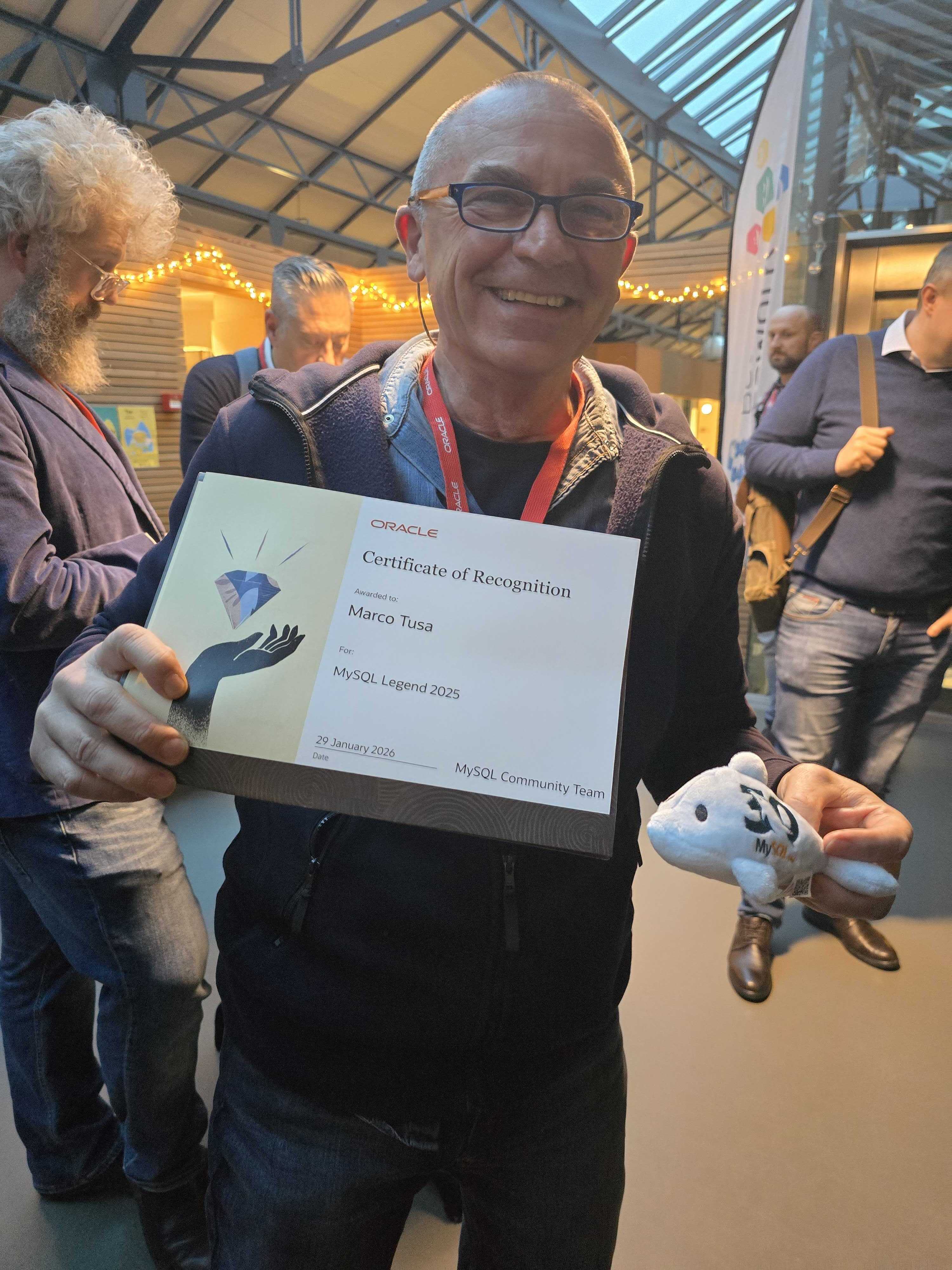
Another highly interesting talk, even if I feel its full power wasn't grasped by everyone in the room, was Arnaud Adant's session on MySQL Binary Log Analytics. The level of detail we can dig into and the way he handled the binlog was excellent. It was a great demonstration of how a well-known topic like the binlog can still hold a few surprises and remain highly relevant, especially when looking at real-world, large-scale scenarios.
During the Belgian Days, I also received the MySQL Legend award, which was totally unexpected for me. It was so unexpected, in fact, that after the final Rockstar nomination, I actually walked out of the room and missed Fred announcing my name! In pure Grinch style, Fred had to come out and drag me back in. I was so embarrassed here is the video of my momentary shame.
Now, what about FOSDEM? Well, FOSDEM is chaos, as we all know, and nobody expects anything less. However, this year we had a single database room for just one day. That meant trying to cram a whole universe into a single jar. As a result, the room was completely full, but the speeches were, at least for me, a bit too high-level and generic. I understand that was the intention given the constraints, but we need to keep this in mind for the future. Ultimately, I wasn't really impressed.
The day after, we had the MariaDB Day, which featured some interesting talks, specifically focusing on what is coming next for MariaDB. I had a few great discussions there and hope we will be able to collaborate when performing future tests.
The Summit for the MySQL Community
Last but not least, on Monday, February 2nd, we held the Summit for the MySQL Community. The event was an open discussion about how we, as a community, can work together to keep the MySQL ecosystem not just alive, but thriving and effective. It was an excellent meeting featuring people from AWS, Bloomberg, Booking, Canonical, WordPress, Oracle, Percona, MariaDB, and more. I don't have the full list, but it was amazing to see everyone together and willing to collaborate.
What became clear to everyone is that our scope is the same. No matter what company we come from, we want to ensure the MySQL/MariaDB/Percona/Whatever-flavor ecosystem continues to meet user needs and expands to tackle upcoming challenges. To do this, we need to focus on improving community interaction, code sharing, and evolution, without getting derailed by useless debates about who is the latest shining rockstar.
The intention is to do this together, Oracle included, assuming they take the right steps. In this regard, there is an open letter to Oracle that we are asking everyone to read; if you agree with its principles, please sign it.
Looking Forward: The Foundation and Ecosystem
Finally, I want to wish the best of luck to Fred (LeFred), who has decided to move on from Oracle and join the MariaDB Foundation, as he announced in his recent blog post. However, I also want to take a moment to answer the question he posed in that post:
"There is an initiative to create a foundation to ‘save’ MySQL, but doesn’t such a foundation already exist? There is a viable alternative for MySQL users: MariaDB. It offers more features, is ready to innovate further, and welcomes your contributions. Let’s work together!"
To answer Fred's question directly: No, that specific, overarching foundation does not quite exist yet and that is exactly what became so clear during Monday's summit. The fact that the MariaDB Foundation is there is fantastic, and we all view it as a vital piece of the larger puzzle we debated.
However, we also recognize that no single entity or fork can accomplish this broader mission alone. The goal of this new foundation initiative isn't to compete with MariaDB, but to build a unified, vendor-neutral space that lifts up the entire ecosystem.
So, let us stay focused on the greater good. Rather than trying to shift entirely into one court or the other, let's build a truly collaborative foundation where all flavors and contributors can thrive together. We have a lot of work ahead of us let's do it side by side.